What Is Sudoku and What Are the Rules?
Classic Sudoku is a 9×9 grid divided into nine smaller 3×3 boxes. Some cells contain digits called givens. Fill the empty cells so that:
- Every row contains the digits 1 through 9 exactly once.
- Every column contains the digits 1 through 9 exactly once.
- Every 3×3 box contains the digits 1 through 9 exactly once.
A cell must satisfy all three conditions. You never add or multiply the digits; they are simply nine different symbols. Beginner puzzles can be solved by eliminating impossible choices rather than trying random numbers.
Try a Real 9×9 Sudoku Puzzle
This is the original board used in the tool and explanations. Dots represent empty cells. R5C5 means row 5, column 5, counting from the upper-left corner.
| Row | C1 | C2 | C3 | C4 | C5 | C6 | C7 | C8 | C9 |
|---|---|---|---|---|---|---|---|---|---|
| R1 | 5 | 3 | . | . | 7 | . | . | . | . |
| R2 | 6 | . | . | 1 | 9 | 5 | . | . | . |
| R3 | . | 9 | 8 | . | . | . | . | 6 | . |
| R4 | 8 | . | . | . | 6 | . | . | . | 3 |
| R5 | 4 | . | . | 8 | . | 3 | . | . | 1 |
| R6 | 7 | . | . | . | 2 | . | . | . | 6 |
| R7 | . | 6 | . | . | . | . | 2 | 8 | . |
| R8 | . | . | . | 4 | 1 | 9 | . | . | 5 |
| R9 | . | . | . | . | 8 | . | . | 7 | 9 |
To paste the same puzzle into the Sudoku Solver, use this 81-character code. Each 0 marks a blank:
530070000600195000098000060800060003400803001700020006060000280000419005000080079
The puzzle has a unique solution. Try finding one forced move before requesting a hint; understanding why a digit belongs in a cell is more useful than seeing the whole answer.
How to Solve Sudoku for Beginners in 5 Steps
1. Scan rows, columns and boxes
Start where several givens already appear. Look for a row with only a few blanks, then check the corresponding columns and boxes. Search for the next position where only one value works instead of trying to remember the entire board.
You can also follow one digit. When that digit appears in two rows crossing the same box, those rows rule out positions for it within the box. Repeat with digits that occur frequently.
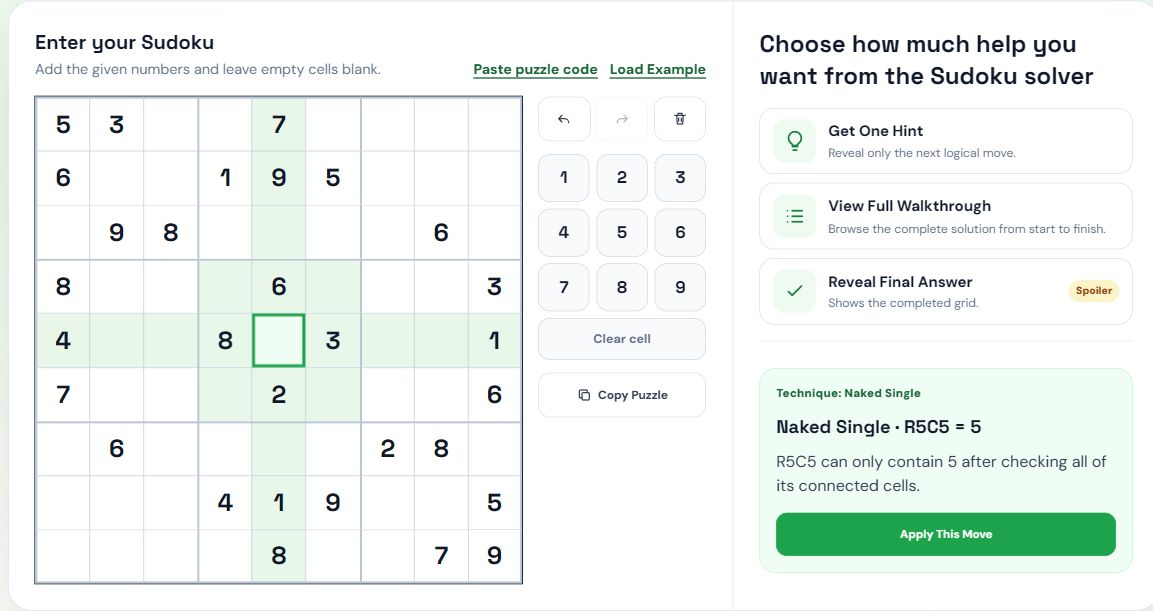
2. Find a naked single: R5C5 = 5
Look at the center cell, R5C5. Row 5 contains 4, 8, 3 and 1, so it is missing 2, 5, 6, 7 and 9.
Column 5 contains 7, 9, 6, 2, 1 and 8, leaving 3, 4 and 5 missing. The only digit common to both lists is 5. The middle box has no 5 either, so write 5 in R5C5.
This is a naked single: after excluding digits already in its row, column and box, one cell has exactly one candidate. You have a reason for the placement, not a guess.
3. Find a hidden single: R3C7 = 5
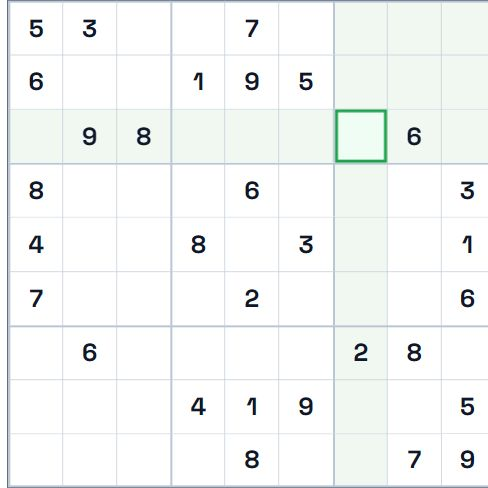
Row 3 of the original board is . 9 8 | . . . | . 6 .. It needs a 5, but only one empty position can hold it:
- R3C1 cannot be 5 because column 1 has a 5 at R1C1.
- R3C4, R3C5 and R3C6 cannot be 5 because their upper-middle box has a 5 at R2C6.
- R3C9 cannot be 5 because column 9 has a 5 at R8C9.
That leaves R3C7 = 5. Viewed alone, R3C7 allows several digits. The 5 is forced because it has no other home within row 3. This is a hidden single.
4. Make pencil marks when choices remain
If a cell allows several digits, keep it undecided. Write the possibilities as small candidate notes on paper or in a separate list. A cell with choices {2, 6} stays empty until another placement removes one option.
Update notes after placing a digit. It removes that value from other cells in the same row, column and box, sometimes creating a new single. In the grid above, enter one digit per cell and keep candidate notes on paper or in a separate list.
5. Repeat the easiest logical move
After placing the two 5s, rescan the affected rows, columns and boxes. On an easy puzzle, alternating between scanning, naked singles and hidden singles often keeps you moving.
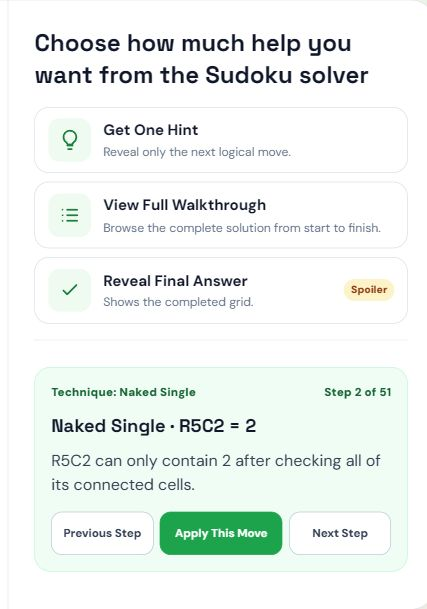
If you cannot prove a move, choose Get One Hint. The tool may find a different valid move from the ones above. Read its explanation and highlighted evidence before applying the step. Use View Full Walkthrough to browse more deductions; Reveal Final Answer is marked as a spoiler and asks for confirmation.
Naked Singles vs. Hidden Singles
For a naked single, ask “What is the only digit allowed in this cell?” For a hidden single, ask “Where is the only place this digit can go within this row, column or box?”
Both use the same three rules and neither requires guessing. Switch between looking at one cell and tracking one digit across a row, column or box.
What to Do When You Get Stuck
First check for an error. Duplicate digits can make later deductions impossible. If you imported a photo, confirm that the givens match the original; one misread digit can invalidate the board.
Next, revisit areas affected by your latest move and update candidates. Do not erase a given to make a guess fit. The solver explains naked singles, hidden singles, locked candidates and naked pairs. If it cannot find another supported logical step, it says so; finding a final solution is not the same as explaining every deduction.
Practice One Deduction at a Time
- Your first newspaper Sudoku: Enter the givens and try to prove a move before requesting help.
- A short daily session: Work on one easy board and mark the moves you can explain.
- Classrooms and tutoring: Ask which existing digit rules out an option. “Column 5 already has a 7” explains more than an unsupported correct answer.
- Printed worksheets: Use the Sudoku Generator for a fresh easy puzzle and answer key, then enter its clues in the solver when you need help.
Common Beginner Mistakes
Checking only a row is a common trap: every candidate must also be allowed in its column and box. Another is guessing because no move looks obvious; an incorrect digit can make the rest of the puzzle seem impossible.
Scan for simple placements before filling every blank with notes. If the board feels overwhelming, find just one justified move, place it, and check again.
FAQ: How to Solve Sudoku for Beginners
What is the easiest way to start solving Sudoku?
Find a row, column or box with several given digits. Check what is missing, rule out illegal candidates, and place only a digit you can prove is forced. Start with naked singles before attempting more complex patterns.
Do I need to be good at math?
No. Standard Sudoku uses number symbols, but the reasoning is about repeated digits and allowed positions, not arithmetic.
How do I solve a 9×9 Sudoku without guessing?
Apply all three rules, scan for naked singles, look for hidden singles, and update candidates after each placement. Harder puzzles may need further techniques. If you cannot explain a move, leave the cell undecided and look elsewhere.
What's the difference between a Sudoku solver and a generator?
A solver helps with a puzzle you already have, using hints, a walkthrough or a final solution. A generator creates a new puzzle and answer key. Word Puzzle World provides both tools.
Can I use a Sudoku solver from a photo?
Yes. The solver accepts a clear image or screenshot and converts the detected grid into editable cells. Review every detected given before asking it to solve anything.
Why does my puzzle say it has no solution or more than one?
A mistyped or misread digit can create a contradiction, while an incomplete set of givens may allow multiple solutions. Check the original grid. The solver reports these conditions so you can correct the input.